
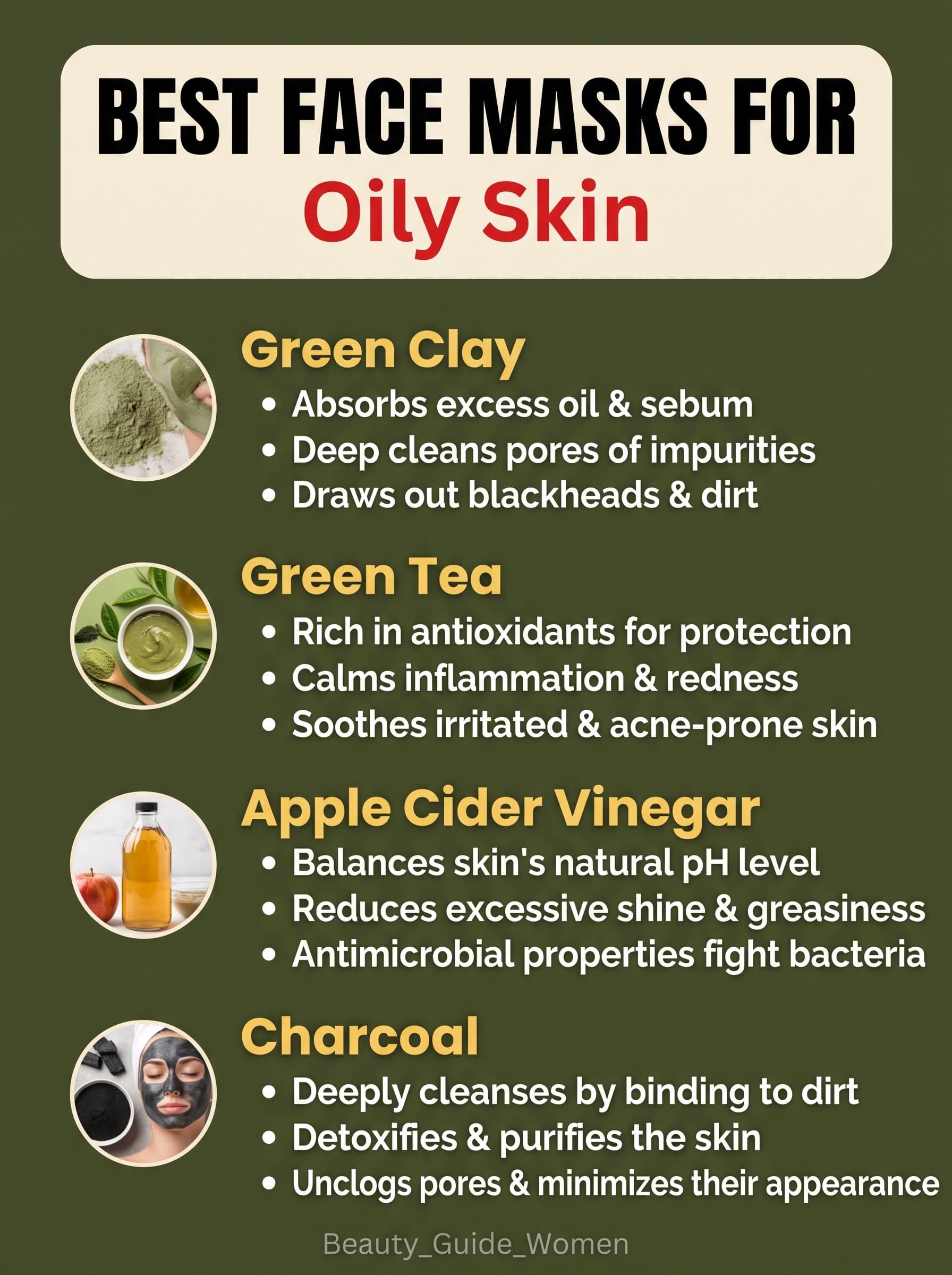
The Best Face Masks for Oily Skin, Ranked by Effort
Green clay, green tea, charcoal, and apple cider vinegar — what each does for oily skin, the dilution rule most people skip, and why over-masking backfires.
First, a reframe that changes everything about oily skin: sebum isn't the enemy. It's the skin's own moisturizer and barrier — the goal is managing how it sits and how much, not waging war on it. Aggressive stripping triggers more oil production a day later, which is exactly how the oil-control product cycle keeps its customers. Masks are for managing, not curing — used weekly, they keep oily skin comfortable without starting the rebound loop.
Green clay is the workhorse. It absorbs oil and debris directly out of the pore as it dries, and it's been doing this since before it came in pretty jars. The rule everyone gets wrong: rinse it off while it's still slightly tacky. A clay mask left until fully dry and cracking is pulling water out of your skin too, and the tight, flushed feeling afterwards is not a sign it worked — it's a sign it overworked. Ten to twelve minutes, warm water, once or twice a week.
Green tea is the zero-effort one. Brew it strong, chill it, and use it as a final rinse or soak a cotton pad and lay it on for ten minutes. Cooled green tea brings antioxidants and a genuinely calming effect on redness, and it's practically free. If your oily skin also runs red and reactive, start here rather than with clay.
Charcoal is the popular one, honestly over-marketed. It does adsorb oil and debris — that's real chemistry — but it's a supporting ingredient, not a miracle, and the practical difference from clay is smaller than the packaging implies. If you like a charcoal mask, use it the same way as clay: occasionally, briefly, never until it cracks.
Apple cider vinegar needs a warning label. Used for its pH and mild exfoliating effect, it must always be diluted — one part vinegar to at least three parts water — and patch-tested near the jaw first, never applied to broken or actively inflamed skin. Undiluted vinegar can chemically burn, and even wrongly diluted it's too harsh for reactive skin. If you'd rather skip the chemistry experiment, a well-formulated toner does the same job with less risk.
The frequency rule matters more than the ingredient: once, maybe twice a week, and always follow with a light moisturizer — yes, even on oily skin, especially on oily skin. Skin that gets some moisture back stops compensating with extra oil. That's the quiet trick of managing oily skin: it calms down when it's cared for, not when it's punished.